 Instant Text Assistive Features  |
25 Educational and Career Glossaries
For students from grade school through post-graduate studies - for term papers, reports, theses, essays, and communication between colleagues - Instant Text Assistive provides classic coursework glossaries at different reading levels, in multiple fields.
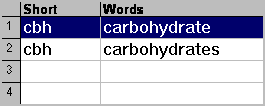
For example, in the Biology101 glossary, words like "carbohydrate" are reduced to 3 keystrokes.
For people who are in the workforce, Instant Text Assistive comes with general business glossaries for correspondence, contracts, email, etc.
In addition, several glossaries can be "active" at the same time, invoking each with one keystroke.
Education subject-specific glossaries are added to, and improved, all the time. Users of Instant Text can download appropriate glossaries for no additional fees.
Glossaries included in Instant Text Assistive
Address
The address glossary just gives a brief example of what an address glossary may look like. Once you develop your own address glossary, you will be able to write any address by typing only two letters, and with Instant Text they expand into the entire address.
This glossary contains the basic words and phrases of Art Appreciation survey courses for the visual arts of drawing, painting, sculpture, ceramics, and tapestry.
This glossary contains the basic vocabulary and phrases of introductory level courses in biology and the study of life.
The vocabulary and phraseology related to US federal, state and municipal governments, politics, citizenship, elections, representation, governmental bodies, legislation, etc.
Useful vocabulary and phrases for writing about computers.
The contract glossary contains legal language and may give you an idea of how frequently used phrases can be typed with only a few keystrokes. It illustrates the kind of continuations you may get with legal language.
The Demo glossary allows you to write long words such as supercalifragilisticexpialidocious with just two letters and green or red. It also includes a few stock phrases that you may use when challenged to show your speed ("Now is the time..." and "The quick brown fox...").
A glossary of the vocabulary and phrases of the studies of dinosaurs. All the big names no one can spell. A great help to anyone writing a report on this popular subject
A glossary of the basic terms and phrases of introductory courses in economics covering ideas in macro- and micro-economic theories and practices.
The Empty glossary gives you the structure of an Instant Text glossary file that is ready to be filled with whatever you want to have in it, should you decide to do glossary entries one by one. You can rename it and make it your personal glossary.
The words and phrases for writing about the environment, including the vocabulary of pollution, conservation, forests, hazardous wastes, rivers, dams, global warming and similar issues.
The General glossary contains the most frequently used long words and phrases. It contains over 900 very commonly used phrases like "in regard to" or "it is true that", "in large part" etc.
A glossary of geographic terms: the physical features of the United States, including rivers, lakes, mountains, cities, states, forests, islands, peninsulas, deserts, plains, etc.
The Internet glossary contains frequent e-mail extensions like @worldnet.att.net and website addresses for car rentals or hotel reservations. You type "her;" and get the Hertz reservation site or "sh" and get the Sheraton website address.
The Legal glossary contains frequently used words and legal terms. This may be used as a starting glossary that should be merged with more specific glossaries automatically compiled from existing documents.
A glossary for writing about physics at the introductory course level, including the terms and phraseology of the nature of matter, solid, liquid and gaseous states, energy, velocity, mass, etc.
A glossary focused on the vocabulary of introductory psychology. It includes terms on individual human behavior, emotions, and other conditions.
Single10 contains the 10 most frequent short words starting with each of the 26 letters of the alphabet ("x" is used for words starting with "ex" like "except"). For these words you only need to type the first letter. Single10 is automatically used by Instant Text to supply one-letter abbreviations.
Note that the Glossary used for single-letter abbreviations is specified in the Insttext.ini file and does not appear in the Glossary list.
The Single_De glossary contains an average of seven of the most frequent German words per letter in the alphabet. For these words you only need to type the first letter.
Single_De can be selected in the Options/Preferences/Others menu. It is then automatically used to supply the German one-letter abbreviations when reopening Instant Text.
The Single_Fr glossary contains an average of five of the most frequent French words per letter in the alphabet. For these words you only need to type the first letter.
Single_Fr can be selected in the Options/Preferences/Others menu. It is then automatically used to supply the French one-letter abbreviations when reopening Instant Text.
The MedSingl glossary contains an average of ten of the most frequent medical words per letter in the alphabet ("x" is used for words starting with "ex" and "x"). For these words you only need to type the first letter.
MedSingl can be selected in the Options/Preferences/Others menu. It is then automatically used when reopening Instant Text.
A glossary of terms and words from the world of sports-writing encompassing the language of all major American sports and many of the players in the news.
The US glossary contains names of cities and states in North America.
USHistory18 USHistory19 USHistory20
Three glossaries of the vocabulary and phraseology for writing about 18th, 19th and 20th century US history from the colonial days through the American revolution, the Civil War, the two World Wars, right up to the presidential administration of Richard Nixon.
More than ten thousand of the most commonly used words in the American English writing vocabulary, for use in composition writing, term papers in any subject, book reports and similar school work.
The world glossary contains names of cities, states, and countries of the world. No need to look up their spelling!
This glossary is compiled from The 1997 World Factbook, in the version made available by The Gutenberg Project.
The World Factbook is prepared by the Central Intelligence Agency for the use of US Government officials, and the style, format, coverage, and content are designed to meet their specific requirements. Information was provided by the American Geophysical Union, Bureau of the Census, Central Intelligence Agency, Defense Intelligence Agency, Defense Nuclear Agency, Department of State, Foreign Broadcast Information Service, Maritime Administration, National Imagery and Mapping Agency, National Maritime Intelligence Center, National Science Foundation (Antarctic Sciences Section), Office of Insular Affairs, US Board on Geographic Names, US Coast Guard, and other public and private sources.
| Next: Try Instant Text | Instant Text Home |